
The Property Institute (TPI) published its first Wellbeing & Resilience Survey Report in 2021 to better understand the key pressures facing residential property management professionals and to identify ways to support them. This is the sixth consecutive year of the survey, and the dataset now spans a period of profound change for the profession, from the acute pressures of the pandemic, through the implementation of the Building Safety Act, to the ongoing challenge of managing leaseholder frustration at rising service charges.
Method
This year's research was conducted using a quantitative approach. An anonymous online questionnaire was distributed via SurveyMonkey and remained open in February and March 2026. The survey consisted of 40 questions, including multiple-choice, Likert scale, and open-text responses. It was shared with both individual and company members from TPI's database and promoted via social media and email.
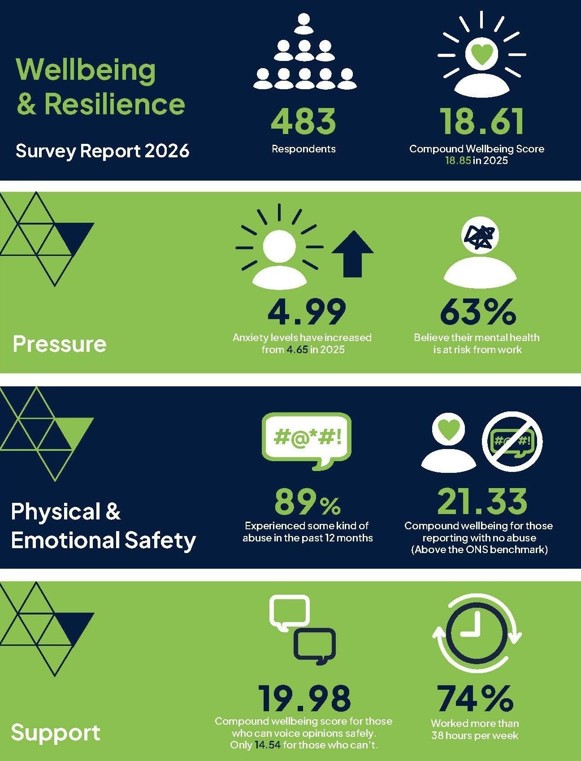
In total, 483 individuals from across the sector responded to this year's survey, with a 100% completion rate. 1,841 verbatim responses were received across seven open questions, all of which have been carefully reviewed in full.
Key Findings at a Glance
- Compound wellbeing score: 18.61 (2025: 18.85; ONS 2026: 20.90)
- 89% experienced some form of abuse in the past 12 months
- 63% believe their mental health is at risk from work
- 45% are leaving or unsure whether they will stay in the profession
- Average workload pressure: 7.37 out of 10 - the highest in six years
- Respondents with no abuse experienced a compound score of 21.33 - above the ONS benchmark
- Employer genuine wellbeing action: compound score of 20.66 vs 14.87 where no action is taken - a gap of 5.79
- Voice (ability to raise concerns safely): compound score of 19.98 vs 14.54 - a gap of 5.44 points
- Four-day week respondents: compound score of 20.67, approaching the ONS benchmark
- Average worked hours: 43.7 - with 74% working more than 38 hours per week.

Looking Ahead
TPI remains committed to translating survey data into meaningful action, through TPI Training, TPI Wellbeing Standard, TPI Guidance Notes, sector-wide advocacy, and the ongoing work of amplifying the voices of those on the front line to customers, government and the media.
The next wellbeing survey will be issued in Q2 of 2027. TPI extends its sincere thanks to all 483 respondents who gave their time, honesty, and insight to this year's report.
The 2026 results show a sector under sustained pressure, but not without cause for hope.
TPI Resources
-
TPI's voluntary wellbeing benchmark enables organisations to assess and improve their approach to employee wellbeing.
The Standard outlines core principles and practical actions for creating psychologically safe, inclusive and supportive work environments, helping employers move beyond ad hoc initiatives towards long-term cultural change.
Download TPI Consumer Charter & Standards HERE and see section 9 for the Wellbeing Standard.
-
Developed alongside the Wellbeing Standard, this detailed guidance notes provide ready-to-use templates, processes, and structured advice for implementing an effective wellbeing programme. It supports both strategic planning and day-to-day decision-making, making it easier for organisations to embed wellbeing into their operations. Applies to TPI Company Members only.
Download HERE -
TPI offers a range of opportunities for members to build knowledge and open conversation around wellbeing. Free Member ‘BrainGain’ webinars cover a variety of topics including wellbeing, providing accessible, expert-led insights that members can take back to their organisations.
TPI Training courses offer structured learning around wellbeing in the workplace, and wellbeing sessions at TPI events explore new ways of approaching challenges faced by property managers today.
View TPI Wellbeing Training courses HERE. -
TPI continues to provide members with:
- Access to de-escalation training developed in partnership with the Suzy Lamplugh Trust and the British Retail Consortium,
- Violence and stress guidance from the Health & Safety Executive,
- Downloadable safeguarding posters designed to remind residents and clients that property managers are people too, deserving of respect and safe treatment in all interactions.
- Hub of Hope, the UK’s largest online directory of mental health support
services, to help staff find local and relevant help - having signposted over one million people since 2017.
-
Companies with their own bespoke UB policy have an 81% rate of employer genuinely acting on wellbeing; those using TPI's template policy 69%; those with no policy 40%. Having a policy signals intent. Whether that intent translates into action is what matters.
Download TPI's Unreasonable Behaviour Policy HERE

